
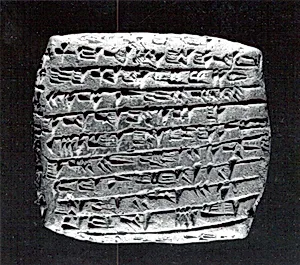
Cuneiform tablet: commercial note
Unknown Artist
ca. 20th–19th century BCE
Medium
Clay
Dimensions
4.3 x 5 x 1.7 cm (1 3/4 x 2 x 5/8 in.)
Classification
Clay-Tablets-Inscribed
Culture & Period
Old Assyrian Trading Colony · Middle Bronze Age–Old Assyrian Trading Colony
Department
Ancient Near Eastern Art
Museum
Metropolitan Museum of Art, New York, NY
Credit
Gift of Mr. and Mrs. J. J. Klejman, 1966
Accession Number
66.245.12
Rights
Public Domain
Art Historical Context
This unassuming clay tablet, inscribed with cuneiform script, served as a commercial note from the Old Assyrian Trading Colony the 20th–19th century. Measuring just 4.3 x 5 x 1.7 cm, it hails from the Middle Bronze in ancient Anatolia (modern-day Turkey), where Assyrian merchants bustling trade outposts like Kanesh. These small, wedge-shaped impressions on soft clay—dried or baked for durability—captured everyday transactions, from commodity exchanges to loans, offering a rare glimpse into one of the world's earliest global trade networks. Cuneiform, the world's oldest writing system, revolutionized communication in the Ancient Near East, evolving from pictographs to abstract signs pressed with a reed stylus. This tablet exemplifies its practical use in commerce, highlighting the Assyrians' savvy entrepreneurship as they shipped tin, textiles, and lapis lazuli across vast distances. Far from art in the modern sense, its "artistic" value lies in its precision and permanence, preserving economic history that might otherwise vanish. A generous gift to the Metropolitan Museum of Art in 1966 from Mr. and Mrs. J. J. Klejman, this artifact bridges us to a time when clay was the medium of business empires, reminding visitors of humanity's enduring drive to connect and trade.