
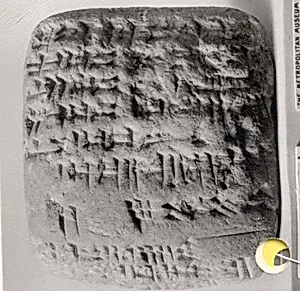
Cuneiform tablet: distribution of barley
Unknown Artist
ca. 1614 BCE
Medium
Clay
Dimensions
6.1 x 5.5 x 2.3 cm (2 3/8 x 2 1/8 x 7/8 in.)
Classification
Clay-Tablets-Inscribed
Culture & Period
Babylonian · Old Babylonian
Department
Ancient Near Eastern Art
Museum
Metropolitan Museum of Art, New York, NY
Credit
Purchase, by exchange, 1911
Accession Number
11.217.28
Rights
Public Domain
Art Historical Context
This unassuming clay tablet, inscribed with cuneiform script around 1614 BCE during the Old Babylonian period, the distribution of barley—a staple crop essential to ancient Mesopotamian life. Measuring just 6.1 x 5.5 x 2.3 cm, it offers a tangible glimpse into the bureaucratic world of Babylon, where administrators meticulously tracked resources to sustain cities, temples, and laborers. Acquired by the Metropolitan Museum of Art in 1911, it exemplifies the everyday documents that fueled one of the world's earliest civilizations. Cuneiform, the world's oldest writing system, was created by pressing a reed stylus into soft clay, forming distinctive wedge-shaped marks that dried or were fired for permanence. This technique revolutionized communication, enabling complex record-keeping far beyond simple tallies. As a product of Babylonian culture in the Ancient Near East, the tablet highlights the society's advanced economy and agriculture, where barley distributions supported everything from royal rations to worker wages. Though not a work of fine art, its historical value is profound: it humanizes the past, revealing the scribes' precision and the rhythms of ancient commerce. Visitors can marvel at how such a small object preserves voices from over 3,600 years ago.