
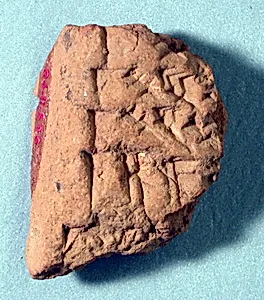
Cuneiform tablet: fragment, Ebabbar archive
Unknown Artist
ca. 7th–4th century BCE
Medium
Clay
Dimensions
0.63 x 1.18 x 1.54 in. (1.6 x 3 x 3.91 cm)
Classification
Clay-Tablets-Inscribed
Culture & Period
Babylonian or Achaemenid · Neo-Babylonian or Achaemenid
Department
Ancient Near Eastern Art
Museum
Metropolitan Museum of Art, New York, NY
Credit
Purchase, 1886
Accession Number
86.11.535
Rights
Public Domain
Art Historical Context
This tiny clay tablet fragment, hailing from the Ebabbar archive, offers a glimpse into the bustling world of ancient Mesopotamia around the 7th to 4th century BCE Likely from the Neo-Babylonian or Achaemen period under Babylonian or Persian rule, bears impressions of cuneiform script—the wedge-shaped writing system invented by Sumerians over 3,000 years. Discovered among records from the Ebabbar temple of Shamash, the sun god, in the city of Sippar, such tablets were everyday tools for scribes managing temple affairs, from land leases to offerings. Crafted from soft clay pressed with a reed stylus while wet, then sun-dried or fired for durability, this medium revolutionized record-keeping. Unlike perishable papyrus, clay ensured longevity, preserving invaluable insights into economy, law, and religion. Though just a fragment (measuring a mere 0.63 x 1.18 x 1.54 inches), it exemplifies how these unassuming objects illuminate the sophisticated bureaucracy of one of history's great civilizations. Acquired by the Metropolitan Museum of Art in 1886, this piece invites visitors to ponder the voices of anonymous scribes whose meticulous work shaped empires long before paper or print. A testament to human ingenuity, it bridges us to the cradle of writing itself.