
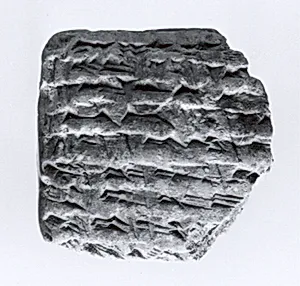
Cuneiform tablet: promissory note for barley
Unknown Artist
ca. 555–539 BCE
Medium
Clay
Dimensions
3.6 x 4.3 x 1.9 cm (1 3/8 x 1 3/4 x 3/4 in.)
Classification
Clay-Tablets-Inscribed
Culture & Period
Babylonian · Neo-Babylonian
Department
Ancient Near Eastern Art
Museum
Metropolitan Museum of Art, New York, NY
Credit
Purchase, 1886
Accession Number
86.11.389a, b
Rights
Public Domain
Art Historical Context
Step back 2,500 years to ancient Babylon with this unassuming clay tablet, a promissory note for barley dated around 555–539 BCE. Measuring just 3.6 x 4.3 x 1.9 cm, it's a snapshot of everyday economic life in the Neo-Bylonian Empire, during the waning years of King Nabonidus's rule, just before the Persian conquest in 539 BCE. Crafted from humble clay, it was inscribed with cuneiform script—wedge-shaped marks pressed into the still-wet surface using a reed stylus—then baked for durability. Cuneiform, one of the world's oldest writing systems, revolutionized record-keeping in the Ancient Near East. This tablet exemplifies Babylonian bureaucracy: a legal IOU ensuring barley delivery, reflecting a sophisticated agrarian economy where grain was currency. Such documents, mass-produced yet precise, highlight the culture's emphasis on contracts, trade, and accountability. Today, housed in the Metropolitan Museum of Art's Ancient Near Eastern Art department (purchased in 1886), it reminds us that history thrives in the mundane. Imagine the scribe's careful hand, sealing a farmer's promise—what stories of harvest and haggling it holds!