
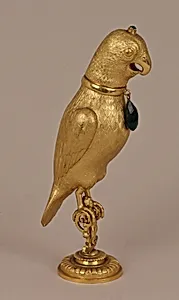
Cup
Unknown Artist
19th century, after 16th century original
Medium
Silver-gilt
Dimensions
Height: 8 1/2 in. (21.6 cm)
Classification
Metalwork-Electrotype
Culture
British, after German original
Department
European Sculpture and Decorative Arts
Museum
Metropolitan Museum of Art, New York, NY
Credit
Gift of Henry G. Marquand, 1883
Accession Number
83.18.119a, b
Rights
Public Domain
Tags
Art Historical Context
This exquisite silver-gilt cup, at 8½ inches tall, is a 19th-century British electro reproduction of a 16-century German original. Housed in the Metropolitan Museum of Art's Department of European Sculpture and Decorative Arts, it was generously gifted by Henry G. Marquand 1883. Adorned with lively parrot motifs—evident from its tags—the cup captures the whimsical yet refined artistry of Renaissance metalwork, where birds often symbolized exoticism, wealth and delight. Electrotyping, the innovative classification here, was a Victorian-era technique using electrolysis to create precise copies of precious objects. This allowed museums and collectors to preserve and study fragile antiques without wear, bridging medieval craftsmanship with industrial precision. Silver-gilt, with its gleaming gold finish over silver, was prized in 16th-century Germany for its opulence, evoking the grandeur of princely courts and ecclesiastical treasures. As a testament to cross-cultural admiration, this cup reflects Britain's 19th-century fascination with Gothic and Renaissance revival styles. Though the original artist remains unknown, its presence in the Met invites us to ponder the enduring allure of intricate metalwork, where form meets fantasy in a feathered flourish.