
Medium
Hard-paste porcelain
Dimensions
Height: 3 3/4 in. (9.5 cm)
Classification
Ceramics-Porcelain
Culture
Austrian, Vienna with Bohemian decoration
Department
European Sculpture and Decorative Arts
Museum
Metropolitan Museum of Art, New York, NY
Credit
Gift of R. Thornton Wilson, in memory of Florence Ellsworth Wilson, 1950
Accession Number
50.211.249
Rights
Public Domain
Tags
Art Historical Context
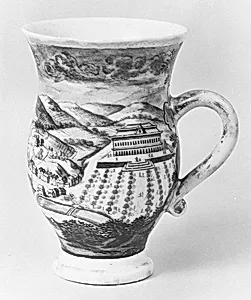
This delicate hard-paste porcelain cup, created around 1740 at the Du Paquier factory in Vienna, represents one of Europe’s earliest successes in mastering the demanding technique of true porcelain production. Founded in 1718, the Viennese manufactory was only the second in Europe—after Meissen—to replicate the translucent strength of Chinese porcelain, a breakthrough that transformed courtly dining and collecting across the continent. Standing just under four inches tall, the cup’s modest scale belies the technical sophistication required to achieve its luminous white body and crisp form. The painted decoration, applied in the Bohemian manner, transforms the vessel into a miniature landscape. Tiny buildings nestle among rugged mountains beneath sweeping skies, reflecting the period’s fascination with idealized nature and travel. Such scenes were often added by independent decorators working outside the factory, a practice especially common in Bohemia that allowed regional artistic traditions to flourish alongside official Viennese production. Today in the Metropolitan Museum’s collection, this cup offers visitors a vivid glimpse of eighteenth-century European innovation and cultural exchange. Its refined proportions and evocative scenery embody the era’s desire to bring distant, romantic vistas into the intimacy of daily life.