
Cup
Unknown Artist
1750–70
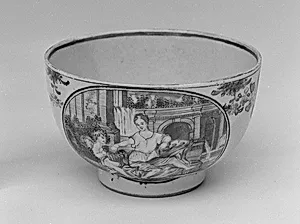
Medium
Hard-paste porcelain
Dimensions
Overall: 1 7/8 × 3 3/16 in. (4.8 × 8.1 cm)
Classification
Ceramics-Porcelain-Export
Culture
Chinese, probably for Continental European market
Department
European Sculpture and Decorative Arts
Museum
Metropolitan Museum of Art, New York, NY
Credit
Helena Woolworth McCann Collection, Gift of Winfield Foundation, 1951
Accession Number
51.86.416
Rights
Public Domain
Tags
Art Historical Context
This exquisite porcelain cup, crafted in China around 1750–70, exemplifies the pinnacle of hard-paste porcelain production during the Qing dynasty. Measuring just 1 7/8 × 3 3/16 inches, its petite scale made it ideal for intimate sips of tea or chocolate, luxuries that captivated European elites. Produced for the Continental European market, the cup features delicate motifs of women and playful putti (cherubic figures), blending Chinese technical mastery with Western decorative tastes. Hard-paste porcelain, a Chinese innovation using kaolin clay fired at high temperatures, yielded a translucent, durable body far superior to earlier soft-paste varieties. This export ware fueled Europe's "Chinoiserie" craze, inspiring factories like Meissen to imitate it. Adorning the Metropolitan Museum of Art's European Sculpture and Decorative Arts collection—thanks to the Helena Woolworth McCann Collection—the cup highlights 18th-century global trade, where Eastern artistry met Western desire. Step closer to admire the intricate painting and gilding, a testament to anonymous Chinese potters' skill in creating objects that crossed oceans and cultures, bridging East and West in everyday elegance.