
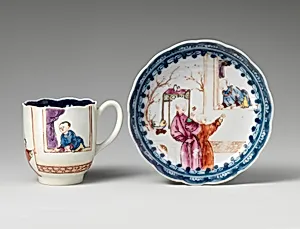
Cup
Unknown Artist
18th century
Medium
Soft-paste porcelain
Classification
Ceramics-Porcelain
Culture
British
Department
European Sculpture and Decorative Arts
Museum
Metropolitan Museum of Art, New York, NY
Credit
Gift of Mrs. Constance D. Stieglitz, in memory of her husband, Marcel H. Stieglitz, 1964
Accession Number
64.142.50
Rights
Public Domain
Tags
Art Historical Context
This elegant 18th-century British cup, crafted from soft-paste porcelain exemplifies the Chinoiserie style that captivated European tastes during the Rococo era. Chinoiserie, meaning "Chinese-esque," drew inspiration from imported Asian ceramics and motifs, blending exotic imagery with Western whimsy. Here, the decoration likely features lively scenes of boys and men in traditional attire, rendered in vibrant enamels over the delicate, creamy body of the porcelain—a material Europeans avidly imitated after China's hard-paste secret was elusive. Soft-paste porcelain, developed in Britain at factories like Chelsea and Bow, marked a triumph of innovation, using a mixture of white clay and ground glass fired at lower temperatures for a luminous glow. This cup reflects the period's opulent decorative arts, where tea and coffee culture fueled demand for such refined tableware. Its presence in the Metropolitan Museum of Art's European Sculpture and Decorative Arts collection, gifted by Mrs. Constance D. Stieglitz in 1964, underscores its enduring appeal as a window into 18th-century Anglo-Chinese cultural exchange.