
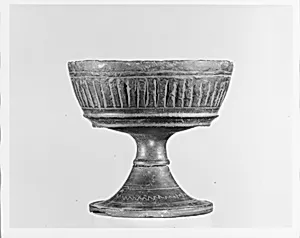
Cup
Unknown Artist
1st half of the 6th century BCE
Medium
Terracotta
Dimensions
5 9/16 in. (14.1 cm)
Classification
Vases
Culture & Period
Etruscan · Archaic
Department
Greek and Roman Art
Museum
Metropolitan Museum of Art, New York, NY
Credit
Purchase, 1896
Accession Number
96.9.130
Rights
Public Domain
Art Historical Context
This delicate terracotta cup, crafted by an unknown Etruscan artist in the first half of the th century BCE, exemplifies Archaic period's vibrant pottery tradition. Standing just 5 9/16 inches (14.1 cm) tall, it belongs to the Metropolitan Museum of Art's Greek and Roman Art collection, through purchase in 1896 As a vase classified within Etruscan wares, it reflects the ingenuity of a culture that thrived in central Italy from around 900 to 100 BCE, bridging the gap between Villanovan iron-age roots and later Roman dominance. Etruscan pottery like this cup was typically wheel-thrown from fine clay and fired to a warm reddish hue, showcasing advanced technical skill for everyday and ceremonial use. During the Archaic era, Etruscans eagerly adopted and adapted Greek influences through trade across the Mediterranean, evident in their bucchero and impasto styles—though this piece's precise form highlights functional elegance over ornate decoration. Cups served practical roles in banquets, libations, and household rituals, underscoring the Etruscans' sophisticated social life. Its survival offers a tangible link to ancient Etruscan society, a civilization celebrated for engineering, art, and prophecy, yet largely absorbed by Rome. Visitors can appreciate how such modest vessels reveal the daily artistry of a people whose legacy shaped Western culture.