
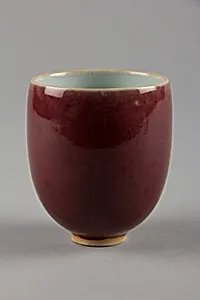
Cup
Unknown Artist
18th century
Medium
Porcelain painted with ox blood red glaze (Jingdezhen ware)
Dimensions
H. 3 3/8 in. (8.6 cm); Diam. 2 3/4 in. (7 cm)
Classification
Ceramics
Culture & Period
China · Qing dynasty (1644–1911)
Department
Asian Art
Museum
Metropolitan Museum of Art, New York, NY
Credit
Bequest of Robert West, 1950
Accession Number
50.221.30
Rights
Public Domain
Art Historical Context
This exquisite porcelain cup, crafted in China's Jingdezhenns during the 18th century Qing dynasty (1644–1911), exemplifies the pinnacle of imperial porcelain production. Standing just 3⅜ inches tall with a 2¾-inch diameter, its petite scale suggests it was designed for intimate use, perhaps savoring tea in a scholar's studio or during refined social gatherings. Jingdezhen, the porcelain capital of the world, supplied the imperial court with wares renowned for their translucency and perfection. The cup's standout feature is its ox-blood red glaze, a sang de boeuf effect achieved through high-temperature firing in a reducing atmosphere, where copper oxide transforms into a deep, shimmering ruby red. This challenging technique, perfected in the Ming dynasty and revived under Qing emperors like Kangxi and Yongzheng, symbolized luxury and technical mastery—flaws were rare, and flawless pieces were treasured. The even, crackled glaze here highlights the potters' skill. In Qing culture, such ceramics bridged utility and art, reflecting China's tea ceremony traditions and the era's opulent aesthetic. Bequeathed to the Metropolitan Museum of Art by Robert West in 1950, this cup invites us to appreciate the enduring elegance of Chinese craftsmanship.