
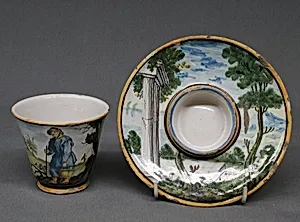
Cup and saucer
18th century
Medium
White-enameled earthenware
Dimensions
Height (cup .63a): 1 3/4 in. (4.4 cm); Diameter (saucer .3b): 4 1/4 in. (10.8 cm)
Classification
Ceramics-Pottery
Culture
Italian, Castelli
Department
European Sculpture and Decorative Arts
Museum
Metropolitan Museum of Art, New York, NY
Credit
Gift of Henry G. Marquand, 1894
Accession Number
94.4.63a, b
Rights
Public Domain
Tags
Art Historical Context
This delicate cup and saucer from 18th-century Castelli, Italy, exemplifies region's renowned tradition in maiolica ceramics. Crafted from white-enameled earthenware tin-glazed technique that provided a smooth, luminous surface ideal for vibrant decorations—the set measures a dainty 1 3/4 inches high for the cup and 4 1/4 inches in diameter for the saucer Produced in Castelli, a hub of Abruzzese pottery-making since the Renaissance, these pieces were prized for their functionality and artistry, blending everyday utility with decorative flair. Castelli workshops flourished in the 18th century, innovating enamel techniques to create durable, brilliantly colored wares often featuring figurative motifs, including scenes with men in pastoral or narrative settings. This gift to the Metropolitan Museum of Art from Henry G. Marquand in 1894 highlights the era's transatlantic appreciation for European decorative arts. As part of the European Sculpture and Decorative Arts collection, it invites visitors to savor the tactile elegance of Italian craftsmanship, evoking the refined tea rituals of aristocratic households.