
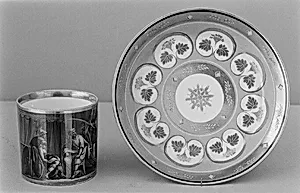
Cup and saucer
1803?–26
Medium
Hard-paste porcelain
Dimensions
Height (Cup): 2 5/8 in. (6.7 cm); Diameter (Saucer): 5 3/8 in. (13.7 cm)
Classification
Ceramics-Porcelain
Culture
Austrian, Vienna
Department
European Sculpture and Decorative Arts
Museum
Metropolitan Museum of Art, New York, NY
Credit
Gift of Alfred Duane Pell, 1902
Accession Number
02.6.155, .156
Rights
Public Domain
Tags
Art Historical Context
This delicate cup and saucer, by the renowned Imperial Porcelain Manuf in Vienna around 1803–1826, exemplifies the height of Austrian porcelain craftsmanship during the Napoleonic era. Crafted from hard-paste porcelain—a durable, translucent material made from kaolin clay that Europeans perfected in the 18th century—this set reflects Vienna's imperial workshops, which supplied Europe's aristocracy with luxurious tableware. The manufactory, established in 1718 and elevated to imperial status, was celebrated for its technical precision and elegant designs blending neoclassical motifs with floral exuberance. Measuring just 2⅝ inches tall for the cup and 5⅜ inches across the saucer, the piece features hand-painted decorations of men amid blooming flowers, likely rendered in vibrant overglaze enamels and gold accents. These motifs evoke the romanticized naturalism and figural scenes popular in early 19th-century decorative arts, symbolizing refinement and leisure. Donated to the Metropolitan Museum of Art in 1902 by Alfred Duane Pell, this everyday luxury object highlights how porcelain bridged art and domestic life, showcasing Vienna's cultural prestige amid shifting European empires.
About the Artist
Imperial Porcelain Manufactory ( ) · 1744 –1864
Vienna, 1744–1864