
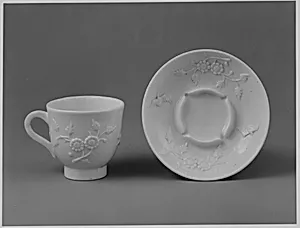
Cup and saucer
1725–50
Medium
Soft-paste porcelain
Dimensions
Height (cup .8): 2 5/8 in. (6.7 cm); Overall (saucer .9): 1 1/8 × 4 3/4 in. (2.9 × 12.1 cm)
Classification
Ceramics-Porcelain
Culture
French, Saint-Cloud
Department
European Sculpture and Decorative Arts
Museum
Metropolitan Museum of Art, New York, NY
Credit
Gift of Mrs. Morris Hawkes, 1924
Accession Number
24.214.8, .9
Rights
Public Domain
Tags
Art Historical Context
This delicate cup and saucer, by the Saint-Cloud in France between 1725 and1750, exemplifies early 18th-century European innovation. Crafted from soft-paste porcelain—a French specialty blending clay, glass frit, and white ash to mimic coveted Chinese hard-paste porcelain—these pieces were fired at lower temperatures, allowing for intricate molding and vibrant overglaze enameling. The cup stands just 2⅝ inches tall, paired with a 4¾-inch saucer, making them perfect for intimate rococo tea rituals among the aristocracy. Saint-Cloud, established around 1696 near Paris, was one of Europe's pioneering soft-paste factories, rivaling Saxony's Meissen in luxury goods. Its wares often featured floral motifs—like the blooming designs hinted at here—painted in vivid enamels of rose pompadour pink, blue, and green, reflecting the era's taste for elegant, nature-inspired decoration. These items symbolized France's growing mastery of porcelain under Louis XV, turning everyday objects into status symbols. Today, this gift to the Metropolitan Museum of Art offers a glimpse into Versailles-era refinement, where porcelain bridged Eastern imports and Western ingenuity. Visitors, imagine sipping chocolate from such fragility— a true luxury of its time!
About the Artist
Saint-Cloud factory · 1693–1766
The Saint-Cloud porcelain factory, situated on the Seine in the town of Saint-Cloud near Paris, revolutionized European ceramics as the first to manufacture soft-paste porcelain commercially, beginning in 1693. Originally established around 1664-1666 as a faience workshop, it shifted to porcelain under Pierre Chicaneau, a potter whose experiments yielded a frit-based paste with a warm yellowish or...