
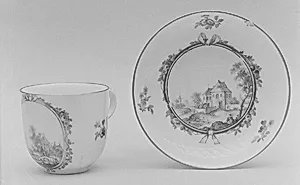
Cup and saucer
Medium
Hard-paste porcelain
Dimensions
Height (cup .225): 2 1/2 in. (6.4 cm); Diameter (saucer .226): 4 5/8 in. (11.7 cm)
Classification
Ceramics-Porcelain
Culture
German, Berlin
Department
European Sculpture and Decorative Arts
Museum
Metropolitan Museum of Art, New York, NY
Credit
The George B. McClellan Collection, Gift of Mrs. George B. McClellan, 1941
Accession Number
42.205.225, .226
Rights
Public Domain
Tags
Art Historical Context
This elegant cup and saucer, crafted by the Royal Porcelainufactory in Berlin around 1775, exemplifies pinnacle of 18th-century European porcelain. Made from hard-paste porcelain—a durable, translucent material developed in Germany using kaolin clay and fired at high temperaturesse pieces were technical marvels. Invented by Meissen a few decades earlier, hard-paste porcelain allowed Berlin's state-sponsored factory, founded by Frederick the Great 1763, to rival Chinese imports and supply luxury tableware to Europe's aristocracy. The manufactory, known as KPM, specialized in finely painted and gilded ceramics, often featuring intricate motifs like buildings, as seen in this set. With the cup standing just 2½ inches tall and the saucer measuring 4⅝ inches across, these diminutive objects were designed for intimate rococo tea rituals, blending functionality with opulent decoration. Their presence in the George B. McClellan Collection at The Metropolitan Museum of Art highlights their enduring appeal as symbols of German craftsmanship during the Enlightenment era. Such porcelain not only showcased artistic virtuosity but also underscored Berlin's rise as a cultural hub, where royal patronage fueled innovation in the decorative arts. Visitors can appreciate how these everyday luxuries encapsulated the era's blend of refinement and technical prowess.