
Cup and saucer
Medium
Hard-paste porcelain
Dimensions
Height (Cup .305): 2 13/16 in. (7.1 cm); Diameter (Saucer .306): 5 1/4 in. (13.3 cm)
Classification
Ceramics-Porcelain
Culture
Austrian, Vienna
Department
European Sculpture and Decorative Arts
Museum
Metropolitan Museum of Art, New York, NY
Credit
The Hans Syz Collection, Gift of Stephan B. Syz and John D. Syz, 1995
Accession Number
1995.268.305, .306
Rights
Public Domain
Tags
Art Historical Context
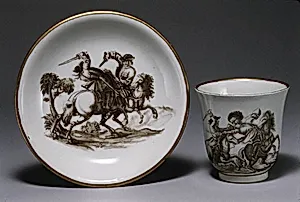
This elegant cup and saucer, around 1725–35 during Vienna's Claudius Innocentius du Paquier period, exemplifies early European mastery of hard-paste porcelain. Produced at the du Paquier factory—the first in Vienna to rival Saxony's Meissen with this prized "white gold"—the set features a delicate cup (2 13/16 inches) and saucer (5 1/4 inches across). Hard-paste porcelain, fired at high temperatures for translucency and strength, marked a technological triumph, unlocking the secrets of Chinese exports for lavish European tables. Vibrant overglaze enamels and gilding bring dynamic battle scenes to life, with charging horses, clashing swords, and armored warriors evoking the grandeur of Baroque military pageantry. Such motifs reflected Austria's imperial ambitions under the Habsburgs, blending artistry with cultural bravado. These pieces were status symbols for the elite, sipped amid rococo splendor. Today, in The Metropolitan Museum of Art's European Sculpture and Decorative Arts collection (gift of the Hans Syz Collection, 1995), this duo invites us to savor 18th-century innovation—one delicate sip at a time.