
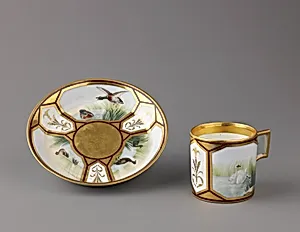
Cup and saucer
Unknown Artist
ca. 1808
Medium
Hard-paste porcelain
Dimensions
Cup: h. 7.3 cm; saucer: diam. 13.5 cm
Classification
Ceramics-Porcelain
Culture
Austrian, Vienna
Department
Robert Lehman Collection
Museum
Metropolitan Museum of Art, New York, NY
Credit
Robert Lehman Collection, 1975
Accession Number
1975.1.1607a,b
Rights
Public Domain
Tags
Art Historical Context
This delicate cup and saucer, around 1808 in Vienna, Austria, exemplifies the refined artistry of the city's imperial porcelain manufactory during the Napoleonic era. Made from hard-paste porcelain—a durable, translucent material pioneered in Europe to rival Chinese imports—these pieces were luxury tableware for the elite, showcasing technical mastery in molding, firing, and glazing. At just 7.3 cm high for the cup and .5 cm in diameter the saucer, their petite scale invited intimate enjoyment of coffee or tea, a fashionable ritual in early 19th-century European salons. The surface is adorned with graceful motifs of ducks and swans, likely hand-painted in vibrant enamels overglaze and fired to a brilliant sheen. These waterfowl symbolize serenity and natural elegance, common in Viennese porcelain designs that blended Rococo whimsy with emerging Neoclassical restraint. Such decoration not only enhanced functionality but also elevated everyday objects into conversation pieces, reflecting the era's Romantic appreciation for nature amid political upheaval. Now part of the Robert Lehman Collection at The Metropolitan Museum of Art (acquired 1975), this anonymous masterpiece highlights Vienna's brief but brilliant porcelain golden age, before economic shifts diminished its dominance. A testament to craftsmanship, it invites us to savor the artistry hidden in the domestic.