
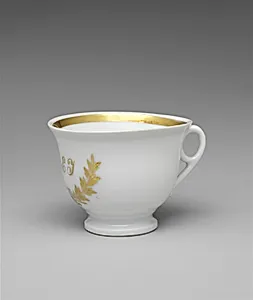
Cup and Saucer
ca. 1838
Medium
Porcelain
Dimensions
Cup: H. 2 7/8 in. (7.3 cm); Diam. 4 1/4 in. (10.8 cm) Saucer: H. 1 1/8 in. (2.9 cm); Diam. 5 1/2 (14 cm)
Classification
Cup and saucer
Culture
American
Department
The American Wing
Museum
Metropolitan Museum of Art, New York, NY
Credit
Rogers Fund, 1963
Accession Number
63.88.11, .19
Rights
Public Domain
Art Historical Context
Nestled in the Metropolitan Museum of Art's American Wing, this delicate cup and saucer from the Tucker Factory circa 1838, early American porcelain production. Founded in Philadelphia by Thomas Tucker the factory was a pioneering venture in the United States, where fine porcelain—typically imported from Europe or Asia—was a luxury symbolizing refinement and status. Crafted from high-quality porcelain, the cup stands 2⅞ inches tall with a 4¼-inch diameter, proportioned to nestle within the 5½-inch saucer, making it ideal for genteel tea rituals of the antebellum era. Porcelain's translucent, vitrified body required advanced kilns and precise formulas, techniques the Tucker Factory mastered to rival European makers like Sèvres or Meissen. Acquired through the Rogers Fund in 1963, this set highlights America's growing industrial ambition during the Jacksonian age, when domestic manufacturing fostered national pride. Though understated in design, its survival speaks to the era's aspiration for elegant everyday objects, bridging utility and artistry in early American material culture. Visitors can appreciate how such pieces graced parlors, fostering social bonds over steaming cups of tea.