
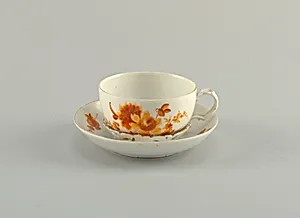
Cup and Trembleuse Saucer
Classification
ceramics
Department
Smithsonian Collection
Museum
Smithsonian American Art Museum
Credit
Bequest of Georgiana L. McClellan
Accession Number
1953-17-30-a,b
Rights
Public Domain
About this artwork
Research in Progress
Art Historical Context
Step into the refined world of 18th-century European porcelain this elegant *Cup and Trembleuse Saucer* from the Meissen Porcelain Manactory, Germany's pioneering ceramics powerhouse founded in 1710. Dating to around 1770, this piece exemplifies Meissen's mastery of hard-paste porcelain—the first true formula developed in Europe, rivaling coveted Chinese imports. The manufactory's artists were renowned for their intricate modeling, delicate gilding, and vibrant overglaze enameling, often drawing from Rococo flourishes or emerging Neoclassical motifs. A standout feature is the trembleuse saucer, a clever innovation with a raised, sloped rim designed to cradle the cup and catch spills from hot beverages like chocolate—a luxury drink among the elite. Popularized in the courts of Louis XV and beyond, these sets blended functionality with opulence, reflecting the era's obsession with exotic imports and sophisticated dining rituals. Meissen's versions elevated the form through technical precision, showcasing the factory's crossed-swords mark as a hallmark of quality. Now part of the Smithsonian American Art Museum's collection through the bequest of Georgiana L. McClellan, this ceramic treasure invites us to savor the artistry of everyday luxury from the Age of Enlightenment. Though research continues, it whispers of porcelain's role in cultural exchange and technical triumph.