
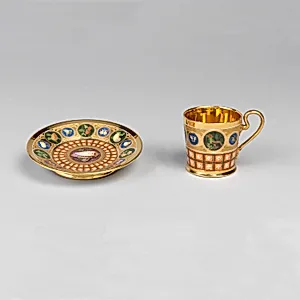
Cup, from a Breakfast Service (Tasse; Déjeuner Mosaïque Florentine)
Classification
ceramics
Department
Smithsonian Collection
Museum
Smithsonian American Art Museum
Credit
Gift of Katrina H. Becker in memory of her parents, Mr. and Mrs. Charles V. Hickox
Accession Number
1981-38-8
Rights
Public Domain
About this artwork
Research in Progress
Art Historical Context
This elegant cup hails from the Sèvres Porcelain Manactory, France's premier porcelain producer established in 1756 royal patronage. Dating to 1813, it forms part of a luxurious *Déjeuner Mosaïque Flor*—a breakfast service whose name evokes the intricate, colorful mosaic techniques inspired by Renaissance Florence, known as *pietra dura*. Crafted during the Napoleonic era's waning years, such pieces exemplified Sèvres' mastery of hard-paste porcelain, often adorned with gilded edges, painted motifs, and jewel-like inlays that mimicked precious stones. Sèvres porcelain was a symbol of French opulence, favored by monarchs and elites for its technical innovation and artistic refinement. By the early 19th century, the manufactory blended neoclassical elegance with Empire style flourishes, producing tableware that turned everyday rituals like breakfast into displays of sophistication. This cup, now in the Smithsonian American Art Museum's collection (gift of Katrina H. Becker in memory of her parents), highlights the enduring allure of Sèvres' ceramics, bridging fine art and functional luxury. Though research continues, the piece invites us to imagine 19th-century salons alive with the clink of such treasures, underscoring porcelain's role in cultural diplomacy and domestic grandeur.