
Cup-shaped Miniature Ornament
Unknown Artist
8th–mid-16th century
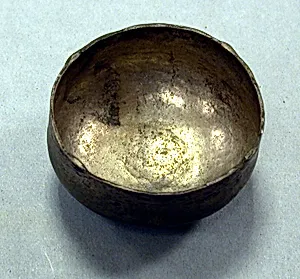
Medium
Silver (hammered), gilt
Dimensions
Depth: 7/8in. (2.2cm) Diameter: 1 15/16in. (5cm)
Classification
Metal-Ornaments
Culture
Peru; north coast (?)
Department
Arts of Africa, Oceania, and the Americas
Museum
Metropolitan Museum of Art, New York, NY
Credit
Gift of Mr. and Mrs. Nathan Cummings, 1964
Accession Number
64.228.455
Rights
Public Domain
Art Historical Context
This delicate cup-shaped miniature ornament, from hammered silver and adorned with gilding, hails from Peru's north coast, likely dating between the 8th and mid-16th centuries Measuring just under 2 inches in diameter less than an inch deep, its petite scale suggests it served as personal adornment—perhaps an earring, pendant, or ceremonial accessory—in pre-Columbian Andean societies Now housed in the Metropolitan Museum Art's Department of the Arts of Africa, Oceania and the Americas, it the collection as a generous gift from Mr. and Mrs. Nathan Cummings in 1964. The broad timeframe spans several cultural horizons on Peru's north coast, from the Lambayeque or Sicán periods through the Inca era and into early Spanish contact, reflecting evolving metalworking traditions in a region renowned for its mastery of precious metals. Hammering the silver created a thin, resonant form, while gilding—applying a thin gold layer via depletion or mercury techniques—added luster and symbolic value, evoking wealth, divinity, or status. Such ornaments highlight the technical prowess of ancient Peruvian artisans, who transformed raw metals into intricate symbols of identity and ritual. Though its exact use remains speculative, this tiny treasure offers a glimpse into the vibrant material culture of coastal Peru, bridging everyday life and cosmology.