
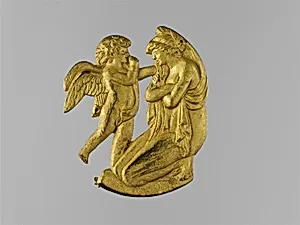
Cupid and Venus Appliqué
ca. 1810–30
Medium
Cast brass, lacquer
Dimensions
2 7/16 x 2 1/4 in. (6.2 x 5.7 cm)
Classification
Appliqué
Department
The American Wing
Museum
Metropolitan Museum of Art, New York, NY
Credit
Gift of Mrs. Edward Hunting Smith, 1968
Accession Number
Inst.68.8.75
Rights
Public Domain
Tags
Art Historical Context
Nestled in The American Wing of the Metropolitan Museum of Art, *Cupid and Venus Appl* by Henry Kellam Hancock (. 1810–30) is a delicate masterpiece of early American metalwork. Crafted from cast brass and finished with lacquer, this petite ornament measures just 2 7/16 x 2 1/4 inches, perfect for adorning furniture or architectural elements. Hancock, a skilled Massachusetts artisan, exemplifies the Federal period's embrace of neoclassical motifs, drawing from ancient Roman mythology to evoke love and beauty through the tender embrace of Venus and her son Cupid. The appliqué's cast brass technique highlights advanced foundry skills of the era, where molten metal was poured into intricate molds to capture fine details like flowing drapery and cherubic forms. Lacquer provided a protective, lustrous sheen, ensuring durability for everyday use in prosperous American homes. This piece reflects the post-Revolutionary fascination with classical antiquity, as seen in the works of designers like Samuel McIntire, blending European influences with burgeoning national pride. As a gift to the Met from Mrs. Edward Hunting Smith in 1968, it offers a glimpse into domestic refinement, reminding us how mythology infused everyday objects with poetic elegance during America's formative years.
About the Artist
Henry Kellam Hancock · 1816–1851
Henry Kellam Hancock (1788–1854) was a prominent American cabinetmaker based in Boston, Massachusetts, where he contributed significantly to the city's early nineteenth-century furniture trade. Son of Captain Belcher Hancock and Ann "Nancy" Susan Ackers, he entered the profession as a chairmaker around 1816 and transitioned to cabinetmaking by 1826, maintaining workshops on Orange Street from abou...