
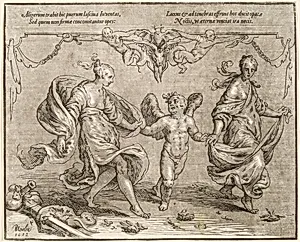
Cupid Dancing with Two Allegorical Women
1612
Medium
chiaroscuro woodcut printed from two blocks in black and gray on laid paper
Dimensions
sheet: 24 x 29.4 cm (9 7/16 x 11 9/16 in.)
Classification
Department
CG-E
Museum
National Gallery of Art, Washington, D.C.
Credit
Ailsa Mellon Bruce Fund
Accession Number
1985.10.1
Rights
Public Domain
Art Historical Context
**Cupid Dancing with Twoorical Women** is a captivating chiaroscuro woodcut Paulus Moreelse, a prominent Dutch artist from Utrecht, created in 1612. Moreelse, known primarily for his elegant portraits and genre scenes during the early Dutch Golden Age, ventured into printmaking with this work, printed from two blocks in black and gray ink on laid paper. Measuring24 x 29.4 cm, it exemplifies the innovative chiaroscuro technique, which uses toned blocks to mimic the dramatic light-and-shadow effects of oil paintings, bringing sculptural depth to woodcuts. The composition depicts Cupid joyfully dancing with two allegorical female figures, evoking themes of love, desire, and perhaps virtue or folly in a playful mythological tableau. This Northern European adaptation of chiaroscuro—popularized by artists like Hendrick Goltzius—made high-art effects accessible through affordable prints, bridging elite painting and broader audiences during the Twelve Years' Truce, a period of cultural flourishing in the Dutch Republic. Acquired through the Ailsa Mellon Bruce Fund and housed in the National Gallery of Art's Prints department (CG-E), this rare piece highlights Moreelse's versatility and the technical sophistication of 17th-century printmaking, inviting visitors to ponder the timeless dance of love's allegories.
About the Artist
Paulus Moreelse · 1571–1638
Comment on works: Architecture; Landscapes; Portraits; History