
Cupid
c. 1615
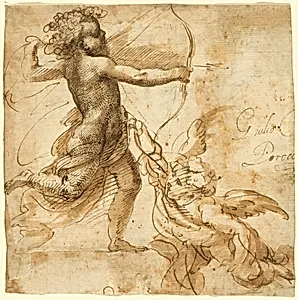
Medium
pen and brown ink with brown wash
Dimensions
overall: 16.8 x 16.8 cm (6 5/8 x 6 5/8 in.)
Classification
Drawing
Department
CG-E
Museum
National Gallery of Art, Washington, D.C.
Credit
Julius S. Held Collection
Accession Number
1985.1.47.a
Rights
Public Domain
Art Historical Context
Behold the delicate charm of *Cupid*, a preparatory drawing by Milanese artist Giulio Cesare Procini, created around 1615. Procaccini (1574–1625), a key figure in Lombardy’s transition from Mannerism to Baroque, captures the mischievous Roman god of love as a winged cherub, likely poised with bow in hand. This intimate square-format sheet (16.8 x 16.8 cm) exemplifies his mastery of fluid lines and emotional expressiveness, bridging the elongated grace of Mannerism with the budding dynamism of the Baroque era. Executed in pen and brown ink heightened with brown wash over a subtle underdrawing, the work showcases techniques prized by 17th-century draftsmen for their versatility. The ink’s precise strokes define Cupid’s contours and musculature, while the wash adds depth and soft modeling, evoking volume on a small scale. Such drawings served as studies for paintings, sculptures, or frescoes, reflecting the era’s emphasis on *disegno*—the intellectual foundation of art. Housed in the National Gallery of Art’s Julius S. Held Collection (CG-E), this gem from a renowned scholar’s holdings highlights Procaccini’s influence in northern Italian workshops. For visitors, it offers a window into the creative process, where mythology meets human tenderness in a single, luminous sketch.
About the Artist
Giulio Cesare Procaccini · 1574–1625
Painter and sculptor, son of Ercole Procaccini. Having moved to Milan with the rest of the family in the mid-1580s, he trained as a sculptor, perhaps in the workshop of Francesco Brambilla (ii), and then worked (1591–9) for the workshop of Milan Cathedral. Italian painter, printmaker.