
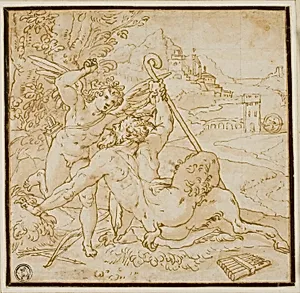
Cupid Overcoming Pan
Medium
Pen and brown ink, with brush and brown wash, squared in black chalk, on ivory laid paper, laid down on ivory laid card
Dimensions
15.8 × 16.1 cm (6 1/4 × 6 3/8 in.)
Classification
pen and ink drawings
Department
Prints and Drawings
Museum
Art Institute of Chicago
Accession Number
80997
Rights
Public Domain
Art Historical Context
Orazio Samacchini’s *Cupid Overcoming Pan* captures a lively mythological contest in which the winged god of love triumphs over the goat-legged deity of untamed nature. Created as a small-scale preparatory drawing, the scene reflects the moralizing themes popular in sixteenth-century Italy, where divine love was often shown subduing earthly passions. Samacchini, a Bolognese artist active during the late Mannerist period, frequently explored such allegorical subjects in both paintings and works on paper. Executed in pen and brown ink with brush-applied wash, the drawing displays confident, fluid contours and subtle tonal modeling that bring the figures to life. The grid of black chalk squares indicates the sheet was used to transfer the composition to a larger surface, most likely a painting or fresco. Measuring just over six inches square, the intimate size invites close inspection of the artist’s quick, expressive line work and economical use of wash to suggest volume and movement. Today housed in the Art Institute of Chicago’s Prints and Drawings department, the sheet offers visitors a rare glimpse into the working process of a Renaissance artist. Its survival underscores the importance of drawings as vital stages in the creation of finished works, preserving both Samacchini’s inventive spirit and the enduring appeal of classical mythology in European art.
About the Artist
Orazio Samacchini · 1532–1577
**Orazio Samacchini** (also spelled Sammachini; 20 December 1532 – 12 June 1577) was an Italian painter of the late Renaissance and Mannerist style, born and died in Bologna. He worked primarily in his native city but also received important commissions in Rome and Parma. Samacchini trained under Pellegrino Tibaldi, though some early sources also link him to Ercole Procaccini. His early work show...