
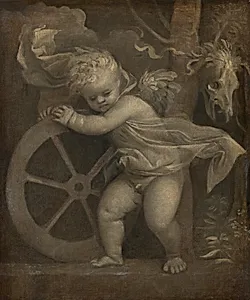
Cupid with the Wheel of Time
Titian, c. 1515/1520
About this artwork
In the early Renaissance masterpiece *Cupid with the Wheel Time*, painted by Titian around 1515–1520, the Venetian artist captures a poignant allegory of love's fleeting nature. This intimate oil-on-canvas work (65.9 × 55.3 cm) depicts the winged god Cupid grasping a spinning wheel, symbolizing the passage of time and fortune's whims—echoing classical motifs of mutability that resonated in Renaissance humanism. Titian, a towering figure of the Venetian school, was then in his twenties, honing his signature *colorito* style, which prioritized vibrant hues and atmospheric depth over Florentine linework. Titian's pioneering use of oil on canvas allowed for the luminous, jewel-like colors and soft modeling that make Cupid's youthful form glow against a shadowy background, evoking both sensuality and melancholy. Likely created for a private patron, this small-scale painting exemplifies the High Renaissance shift toward emotional expressiveness and mythological themes, bridging Giorgione's poetic landscapes and Titian's later grandeur. Housed in the National Gallery of Art as part of the Samuel H. Kress Collection, it invites visitors to ponder timeless questions: How does love turn on fortune's wheel? A gem of Titian's early genius, it showcases Venice's golden age of art.