
Cushion Cover
Qing dynasty (1644–1911), 1800/25
Medium
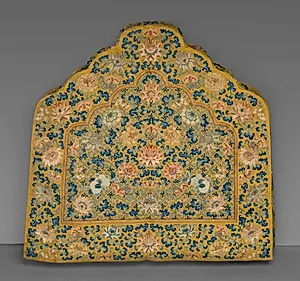
Front and sides of irregular chair cushion. Satin stitch, stem stitch, knots and couching on yellow twill ground. Lined with coarse yellow damask. Cloud design. Front and sides of irregular chair cushion. 5 sided, 2 sides scalloped. Satin stitch, stem stitch, knots and couching on yellow twill ground. Center panel: symmetric design of lotus, bats, peonies, peaches, diamond symbols and scrolls on ground of all over blue swa etika altersating with pink quatrefoil in frame of 4 juiheads. Double gold stripe around central panel. Border and edge which covered thickness of cushion: blue scroll meander with peony, lotus, bats and diamonds. Lined with coarse yellow demask. Cloud design.
Dimensions
62.3 × 66.3 cm (24 1/2 × 26 1/8 in.)
Classification
textile
Department
Textiles
Museum
Art Institute of Chicago
Accession Number
86496
Rights
Public Domain
Art Historical Context
This exquisite Cushion Cover, crafted by Manchu artisans during the Qing (1644–1911) around 1800–1825, exemplifies the opulent textile arts of imperial China. Designed as the front and sides of irregular, five-sided chair cushion—with two scalloped edges—it measures 62.3 66.3 cm and was likely used in elite households to adorn furniture, blending functionality with lavish decoration. The yellow twill ground, lined with coarse yellow damask provided a vibrant base for intricate embroidery, reflecting the Qing era's emphasis on symmetry, abundance, and auspicious symbolism amid a prosperous yet transitional period. At its heart is a symmetric central panel featuring lotus flowers (symbolizing purity), bats (for happiness, as their name echoes "fu"), peonies (wealth and honor), peaches (longevity), diamond motifs, and scrolls, set against an all-over pattern of blue swastikas (ancient symbols of eternity) alternating with pink quatrefoils, framed by four ruyi heads (scepters granting "as you wish" blessings). A double gold stripe encircles it, while the border boasts a blue scroll meander with repeating peonies, lotuses, bats, and diamonds. Employing satin stitch for smooth fills, stem stitch for outlines, knots for texture, and couching for raised gold threads, the piece showcases masterful Manchu needlework techniques that conveyed wishes for prosperity and harmony. Housed in the Art Institute of Chicago's Textiles Department, this cushion cover highlights how everyday objects in Qing China doubled as talismans of good fortune, offering visitors a tactile glimpse into the refined aesthetics and cultural aspirations of the Manchu courtly world.
About the Artist
Manchu
"Manchu" is a cultural and ethnic designation used in museum collection records to identify objects, textiles, costumes, and decorative arts associated with the Manchu people, a Tungusic group originating from the regions northeast of the Great Wall of China. The Manchus rose to political dominance in 1644 when they conquered the declining Ming dynasty and established the Qing dynasty, which ruled...