
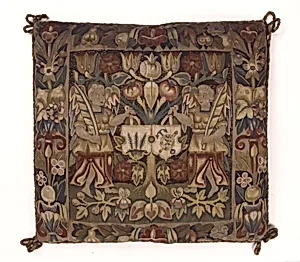
Cushion Cover with Coats of Arms
Unknown Artist
1600–1650
Medium
Linen, wool, and silk in a slit tapestry weave; Backing: cotton weft-float and silk in slit tapestry weave; Cord edging: wool z ply
Dimensions
20 15/16 x 21 3/16 in. (53.2 x 53.8cm) without cord bows at corners
Classification
Textiles-Tapestries
Culture
Northern Germany, probably Hamburg
Department
Robert Lehman Collection
Museum
Metropolitan Museum of Art, New York, NY
Credit
Robert Lehman Collection, 1975
Accession Number
1975.1.1925
Rights
Public Domain
Tags
Art Historical Context
This exquisite *Cushion Cover with Coats of Arms*, in northern Germany—likely Hamburg—between 1600 and 1650, offers a glimpse into the opulent domestic life of the era's merchant elite. Measuring just over 21 inches square this functional yet finely wrought textile would have adorned a cushioned seat in a household, proudly displaying heraldic symbols alongside delicate motifs of flowers and angels. Hamburg's thriving trade as a Hanseatic port city fueled such lavish commissions, where textiles served as status symbols, blending utility with heraldic pride. The cover's front employs a slit tapestry weave in linen, wool, and silk, a technique ideal for small-scale works where colored weft yarns create crisp patterns without interlocking warps, resulting in characteristic slits along color boundaries. The reverse features cotton weft-float and silk in a similar weave, with wool z-ply cord edging and corner bows adding durability and elegance. This meticulous craftsmanship highlights the anonymous weaver's skill in balancing vibrant hues and intricate designs, typical of 17th-century northern European tapestry traditions. Today, housed in the Metropolitan Museum of Art's Robert Lehman Collection, this piece underscores the cultural role of textiles in preserving family lineage and artistry, inviting us to appreciate the hidden mastery behind everyday luxury.