
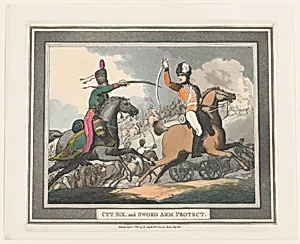
Cut Six, and Sword Arm Protect
September 1, 1798
Medium
Hand-colored etching and aquatint
Dimensions
Sheet: 12 1/16 in. × 15 in. (30.7 × 38.1 cm) Plate: 10 13/16 × 13 1/16 in. (27.5 × 33.1 cm)
Classification
Prints
Department
Drawings and Prints
Museum
Metropolitan Museum of Art, New York, NY
Credit
The Elisha Whittelsey Collection, The Elisha Whittelsey Fund, 1959
Accession Number
59.533.763(16)
Rights
Public Domain
Tags
Art Historical Context
Step into the lively world of 18th-century swordplay with *Cut Six, and Sword Protect*, a hand-colored and aquatint crafted in 1798 by fencing master Henry Angelo and renowned caricaturist Thomas Rowlandson. during the height of the Napoleonic Wars, this print captures the precision and drama of military maneuvers, likely from Angelo's instructional series on fencing techniques. The title refers to specific sword cuts—"Cut Six" for a downward strike—and protective arm positions, blending practical combat training with artistic flair. Rowlandson's masterful hand-coloring brings vivid energy to the scene, highlighting soldiers, men, and rearing horses in dynamic poses amid battle-like action. Aquatint, a tonal printmaking technique pioneered in the late 1700s, allowed for rich, painterly effects that mimicked watercolor, making such affordable prints popular for educating and entertaining the public on martial arts. Housed in the Metropolitan Museum of Art's Drawings and Prints department (The Elisha Whittelsey Collection, 1959), this 12-by-15-inch sheet reflects Britain's wartime obsession with cavalry and swordsmanship. It offers a window into how prints democratized elite skills, turning technical instruction into accessible, thrilling art.
About the Artist
Henry Angelo|Thomas Rowlandson (British|British) · 1756 |1757 –1835 |1827
British, London 1756–1835 London|British, London 1757–1827 London