
Cylinder seal
Unknown Artist
ca. 15th–14th century BCE
Medium
Faience
Dimensions
1.25 in. (3.18 cm)
Classification
Faience-Cylinder Seals
Culture & Period
Mitanni · Mitanni
Department
Ancient Near Eastern Art
Museum
Metropolitan Museum of Art, New York, NY
Credit
Rogers Fund, 1956
Accession Number
56.81.14
Rights
Public Domain
Tags
Art Historical Context
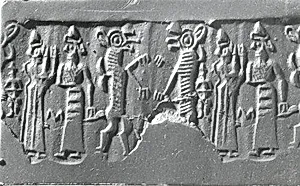
This exquisite cylinder seal, crafted by an unknown Mitanni artist around the 15th–14th century BCE, exemplifies the refined artistry of the Mitanni kingdom, a powerful Hurrian-speaking culture in northern Mesopotamia and Syria. Measuring just 1.25 inches (3.18 cm), these yet intricate objects were essential tools for ancient administrators, rolled across clay tablets or envelopes to imprint ownership marks, authenticate documents, or secure goods. Housed in the Metropolitan Museum of Art's Ancient Near Eastern Art Department (acquired via the Rogers Fund in 1956), it reflects the Mitanni's sophisticated bureaucracy and cultural exchanges with neighboring powers like Egypt and the Hittites. Made of faience—a composite of quartz, lime, and clay fired with a vibrant turquoise glaze—this seal mimics the prized deep-blue lapis lazuli, making luxury accessible. Faience's glassy surface preserved fine details, allowing for lively engravings of human figures and animals, as suggested by its motifs. These dynamic scenes, common in Mitanni seals, often depicted heroic combats or processions symbolizing power and protection, blending realism with symbolic flair. As a window into daily life and mythology over 3,500 years ago, this seal highlights the Mitanni's artistic legacy—bridging administrative function with aesthetic beauty—and invites us to unroll the stories etched in ancient clay.