
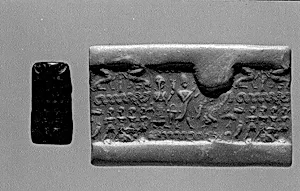
Cylinder seal
Unknown Artist
ca. 1720–1650 BCE
Medium
Hematite
Dimensions
H. 2.6 cm x Diam. 1.4 cm
Classification
Stone-Cylinder Seals
Period
Old Syrian
Department
Ancient Near Eastern Art
Museum
Metropolitan Museum of Art, New York, NY
Credit
Gift of The Right Reverend Paul Moore Jr., 1985
Accession Number
1985.357.3
Rights
Public Domain
Tags
Art Historical Context
This exquisite hematite cylinder seal, dating the Old Syrian period (. 1720–1650 BCE), exemplifies the artistry of ancient Near Eastern civilizations. Measuring just 2.6 cm high and 1.4 cm in diameter, was designed to be rolled across wet clay, imprinting its intricate carvings as a mark of ownership, authentication, or ritual significance. Crafted from durable hematite—a dense, iron-rich stone prized for its resistance to wear—the seal features human figures, depicting scenes from daily life, mythology, or divine worship, though specifics remain enigmatic due to its compact scale. Cylinder seals like this one revolutionized administration in Bronze Age Mesopotamia and Syria, serving as personal "signatures" for elites in trade, diplomacy, and governance. Originating around 3500 BCE, they bridged art and bureaucracy, preserving narratives in miniature form that archaeologists later unroll for study. The Old Syrian style often blended local traditions with Mesopotamian influences, showcasing fluid compositions and symbolic motifs that reflected a worldview intertwined with gods and kings. Housed in the Metropolitan Museum of Art's Ancient Near Eastern Art department (gift of The Right Reverend Paul Moore Jr., 1985), this seal invites us to marvel at the precision of ancient engravers, who wielded fine tools to etch details visible only under magnification. It whispers of a sophisticated society where even the tiniest object carried profound cultural weight.