
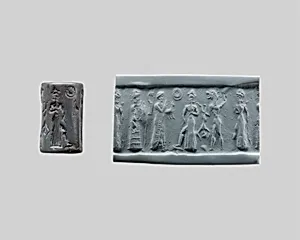
Cylinder seal
Unknown Artist
ca. 19th–16th century BCE
Medium
Hematite
Dimensions
0.98 in. (2.49 cm)
Classification
Stone-Cylinder Seals
Culture & Period
Babylonian · Old Babylonian
Department
Ancient Near Eastern Art
Museum
Metropolitan Museum of Art, New York, NY
Credit
Gift of Martin and Sarah Cherkasky, 1986
Accession Number
1986.311.39
Rights
Public Domain
Tags
Art Historical Context
This exquisite hematite cylinder seal, dating the Old Babylonian period (. 19th–16th century BCE), offers a glimpse into the sophisticated world of ancient Mesopotamia. Crafted by an unknown Babylonian artist, these small stone cylinders—measuring just 0.98 inches (2.49 cm)—were revolutionary tools for authentication. Rolled across wet clay, they left raised impressions that sealed documents, goods, or, blending artistry with practical administration. Carved in remarkable detail despite its diminutive size, the seal features animals and human figures, motifs common in Babylonian art symbolizing power, protection, or mythology. Hematite, a dense and durable iron ore, was prized for its hardness, enabling fine engravings that captured dynamic scenes when impressed. Such seals often held magical or religious significance, invoking deities to safeguard transactions. Housed in the Metropolitan Museum of Art's Department of Ancient Near Eastern Art, this piece was a generous gift from Martin and Sarah Cherkasky in 1986. It exemplifies how everyday objects from 4,000 years ago reveal a culture's ingenuity, artistry, and bureaucratic prowess—perfect for pondering the ancient roots of security seals we use today!