
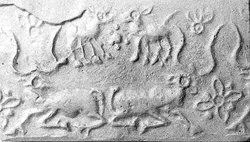
Cylinder seal and modern impression: two horned animals, rosettes
Unknown Artist
ca. 3100–2900 BCE
Medium
Clinoenstatite (sometimes referred to as "glazed steatite")
Dimensions
H. 1 3/8 in. (3.5 cm); D. 11/16 in. (1.8 cm)
Classification
Stone-Cylinder Seals
Culture & Period
Proto-Elamite · Proto-Elamite
Department
Ancient Near Eastern Art
Museum
Metropolitan Museum of Art, New York, NY
Credit
Gift of Nanette B. Kelekian, in memory of Charles Dikran and Beatrice Kelekian, 1999
Accession Number
1999.325.104
Rights
Public Domain
Tags
Art Historical Context
This exquisite Proto-Elamite cylinder seal, dating to around 3100–2900 BCE, offers a glimpse into one of the earliest urban societies in ancient Iran. Carved from clinoenstatite—a, glossy stone often called "glazed steatite"—it measures just 1 3/8 inches high and 11/16 inches in, yet demonstrates remarkable lapidary skill. Cylinder seals like this were revolutionary tools in the Ancient Near East, rolled across soft clay to leave impressions that authenticated documents, goods, or ownership in burgeoning administrative systems. The seal's design features two dynamic horned animals—likely stylized goats or ibexes—flanking rosettes, floral motifs symbolizing fertility or divine favor. These lively engravings, visible in the modern impression, reflect Proto-Elamite artistry's focus on symmetry and nature-inspired themes, bridging prehistoric and historical eras. Such seals mark the transition to complex societies, predating full writing systems and hinting at early Proto-Elamite script influences. Housed in the Metropolitan Museum of Art's Ancient Near Eastern Art department (gift of Nanette B. Kelekian, 1999), this tiny artifact underscores the cultural sophistication of Proto-Elamites, whose innovations in sealing technology influenced Mesopotamia and beyond. A testament to ancient ingenuity, it invites us to marvel at how such precise carvings secured the world's first bureaucracies.