
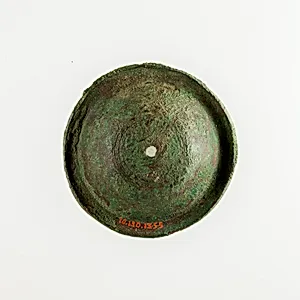
Cymbal
Unknown Artist
30 B.C.–A.D. 364
Medium
Copper Alloy
Dimensions
h. 1.3 cm (1/2 in); diam: 5.9 cm (2 5/16 in)
Classification
Music, cymbal
Period
Roman Period
Department
Egyptian Art
Museum
Metropolitan Museum of Art, New York, NY
Credit
Gift of Helen Miller Gould, 1910
Accession Number
10.130.1355
Rights
Public Domain
Art Historical Context
This delicate copper alloy cymbal, dating from the Roman Period in Egypt (30 B.C.–A.D. 364), offers a glimpse into the everyday rhythms of ancient life. Measuring just 1.3 cm high and 5.9 cm in diameter, its petite size belies its role as a percussion instrument, likely used in musical performances, rituals, or processions. Crafted from a durable copper alloy—similar to bronze—this artifact showcases the metallurgical expertise of Roman-era Egyptian artisans, who hammered and possibly cast the metal to create a resonant surface perfect for clashing pairs. In the context of Roman Egypt, following Cleopatra's defeat and the province's integration into the empire, such instruments bridged pharaonic traditions with Greco-Roman influences. Cymbals were staples in temple ceremonies honoring deities like Hathor or Isis, their sharp, shimmering sounds invoking divine presence and ecstatic worship. This example, now in the Metropolitan Museum of Art's Egyptian Art collection thanks to a 1910 gift from Helen Miller Gould, highlights the cultural fusion of the era—Egyptian craftsmanship enduring under Roman rule. Though the artist remains unknown, the cymbal's survival speaks to its value, preserved for over 1,800 years. Visitors can imagine it echoing through Nile Valley festivals, a tiny testament to music's timeless power in ancient societies.