
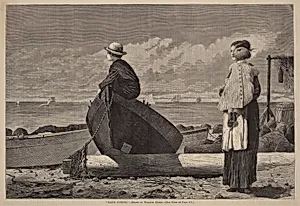
"Dad's Coming!"
published 1873
Medium
wood engraving on newsprint
Dimensions
image: 23.5 x 34.7 cm (9 1/4 x 13 11/16 in.) sheet: 28.3 x 40.5 cm (11 1/8 x 15 15/16 in.)
Classification
Department
CG-W
Museum
National Gallery of Art, Washington, D.C.
Credit
Avalon Fund
Accession Number
1986.31.120
Rights
Public Domain
Art Historical Context
**"Dad's Coming!" Winslow Homer (published 1873)** This charming wood engraving on newsprint a heartfelt moment of childhood anticipation, with the title evoking the joy of a father's return home. Created after Winslow Homer, the renowned American Realist painter and illustrator, it reproduces one of his signature black-and-white drawings originally published in *Harper's*. Measuring 23.5 x 34.7 cm, the image exemplifies Homer's skill in depicting everyday American life during the post-Civil War era, a time when sentimental family scenes offered comfort amid rapid industrialization and social change. Wood engraving, a precise intaglio technique where fine lines are incised into hardwood blocks, allowed for high-quality mass reproduction in newspapers and magazines—revolutionizing visual storytelling in 19th-century America. Homer, a master of this medium early in his career, used dramatic light, expressive figures, and subtle textures to convey emotion, bridging fine art and popular illustration. Acquired through the Avalon Fund for the National Gallery of Art's print collection, this work highlights Homer's influence on American visual culture, blending realism with universal themes of home and reunion. (178 words)
About the Artist
after Winslow Homer
"After Winslow Homer" is the conventional attribution in art historical catalogs for a body of mid- to late-19th-century wood engravings that reproduce the illustrations drawn by the eminent American realist painter Winslow Homer (1836–1910) for popular periodicals, most notably Harper's Weekly. Beginning in 1857, shortly after Harper's Weekly launched in New York, Homer contributed hundreds of sk...