
Dagger-Ax (Ge)
Unknown Artist
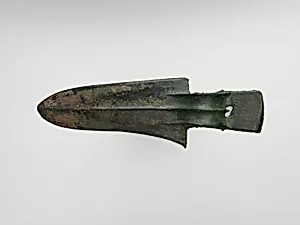
Medium
Bronze
Dimensions
L. 8 11/16 in. (22.1 cm); W. 2 3/4 in. (7 cm)
Classification
Metalwork
Culture & Period
China · Shang dynasty (ca. 1600–1046 B.C.)
Department
Asian Art
Museum
Metropolitan Museum of Art, New York, NY
Credit
Gift of Mrs. C. Dingwall, on Behalf of Lt. Col. Kenneth Dingwall, in memory of Pilot Officer William H. Dingwall, Royal Air Force Volunteer Reserve, Eagle Squadron, 1947
Accession Number
47.87
Rights
Public Domain
Art Historical Context
This exquisite Dagger-Ax, known as a *ge* in ancient Chinese, hails from China's Shang dynasty (ca. 0–1046 B.C.), a formative era of early Bronze Age civilization. Crafted in bronze, it measures 8 11/16 inches long and 2 3/4 inches wide, the period's mastery of metalwork. The Shang were pioneers in bronze casting, using innovative piece-mold techniques to weapons that were both functional and symbolically potent, often serving in warfare, rituals, and elite burials. As a bladed weapon with a central tang for hafting to a wooden shaft, the *ge* highlights the militaristic society of the Shang, where rulers wielded such arms to assert power and connect with the divine. Its sleek form reflects the era's emphasis on symmetry and durability, making it a prime example of Asian Art metalwork. Though the artist remains unknown, this piece speaks volumes about technological prowess and cultural reverence for bronze as a sacred material. Today, it graces the Metropolitan Museum of Art, a generous gift honoring Pilot Officer William H. Dingwall. Visitors, imagine the clash of these blades in ancient battles or ceremonies— a tangible link to China's storied past!