
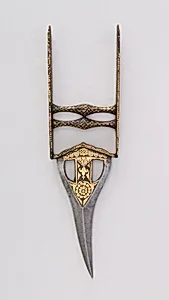
Dagger (Katar)
Unknown Artist
18th century
Medium
Steel, gold
Dimensions
H. 11 13/16 in. (30 cm); W. 3 1/4 in. (8.3 cm); Wt. 12.4 oz. (351.5 g)
Classification
Daggers
Culture
Indian
Department
Arms and Armor
Museum
Metropolitan Museum of Art, New York, NY
Credit
Bequest of George C. Stone, 1935
Accession Number
36.25.917
Rights
Public Domain
Art Historical Context
Step into the riveting world of 18th Indian arms with this exquisite *Katar*, a punch dagger embodying both lethal function and opulent artistry. Crafted high-quality steel with lavish gold accents, its H-shaped hilt—measuring 11 13/16 inches high and weighing a substantial 12.4 ounces—allowed warriors to grip and thrust with precision and power. This design, unique to South Asian weaponry, made the katar a favorite among Rajput nobles and Mughal elites, who prized it as a symbol of martial prowess and status. The dagger's steel blade, likely forged with advanced Indian metallurgical techniques for sharpness and resilience, is elevated by intricate gold inlays or koftgari work, a hallmark of the period's decorative metalcraft. Such embellishments transformed utilitarian arms into wearable jewels, reflecting the cultural fusion of warfare and aesthetics in pre-colonial India. Often sheathed in velvet or leather (though not preserved here), katars were paraded in courtly processions, underscoring the wearer's wealth and valor. Bequeathed to the Metropolitan Museum of Art by collector George C. Stone in 1935, this piece from the Arms and Armor department invites us to ponder the artistry behind India's storied warrior traditions, where beauty and battle intertwined seamlessly.