
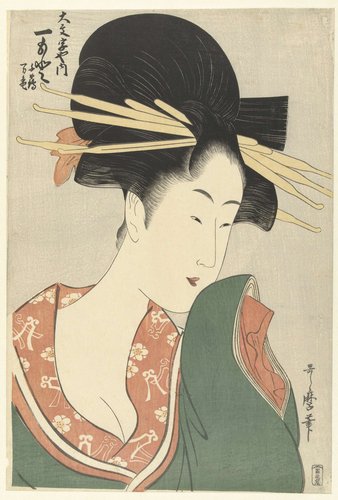
Daimonjiya uchi Hitomoto
Kitagawa Utamaro, c. 1795 - c. 1800
About this artwork
**Daimonjiya uchi Hitomoto** is a captivating color woodcut by Kitagawa Utamaro one of the masters of ukiyo-e, Japan's "pictures of the floating world," created around 1795–1800 the Edo period. This, measuring 383 mm high by 259 mm wide (a standard ōban format), likely portrays Hitomoto, a courtes or beauty from the Daimjiya house in Yoshiwara, Tokyo's famed pleasure district. Utam's bijin-ga (images of beautiful women) celebrated the elegance of these women, capturing their poise, intricate kimonos, and subtle expressions amid the vibrant urban life of 18th-century Japan. Utamaro's genius shines in his innovative woodblock techniques, employing nishiki-e (brocade prints) with up to 10–20 color blocks for luminous gradients and fine textures. His flowing lines and intimate close-ups revolutionized portraiture, emphasizing psychology and fashion over rigid poses. These affordable prints democratized art, adorning homes of merchants and samurai alike. This work exemplifies ukiyo-e's cultural pulse—ephemeral pleasures, fashion, and sensuality—preserving a snapshot of Yoshiwara's allure before Utamaro's death in 1806. A window into Japan's golden age of printmaking, it invites us to admire the artistry behind everyday beauty. (198 words)