
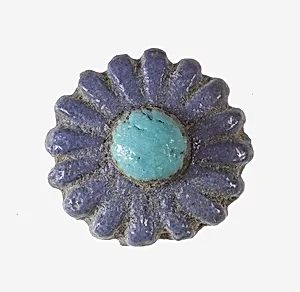
Daisy Pendant
Unknown Artist
ca. 1390–1352 B.C.
Medium
Faience
Dimensions
Diam. 1.3 cm (1/2 in)
Classification
Pendant, daisy
Period
New Kingdom
Department
Egyptian Art
Museum
Metropolitan Museum of Art, New York, NY
Credit
Rogers Fund, 1911
Accession Number
11.215.246
Rights
Public Domain
Tags
Art Historical Context
Behold the delicate *Daisy Pendant*, a marvel from ancient Egypt's New Kingdom, around 1390–1352 B.C. during Dynasty 18. Measuring just 1.3 cm in diameter, this faience jewel—glazed ceramic fired to a vibrant turquoise hue—captures the form of a daisy flower, likely worn as a pendant on a necklace or earrings. Faience was prized for mimicking the luster of semiprecious stones likeis lazuli, making luxurious beauty accessible beyond the elite. In the opulent era of pharaohs like Amenhotep III and Tutankhamun, such floral motifs symbolized renewal, life, and the eternal cycle of nature, evoking the Nile's fertile bounty. Artisans masterfully molded and glazed the frit-based material, achieving a glassy sheen through low-temperature firing—a technique that highlighted Egypt's ingenuity in miniature jewelry. This pendant, acquired via the Rogers Fund in 1911, exemplifies the refined aesthetics of New Kingdom adornments, blending everyday elegance with profound symbolism. Today, at the Metropolitan Museum of Art's Egyptian Art department, it invites us to marvel at how a single flower could encapsulate the ancient Egyptians' reverence for beauty and the divine.