
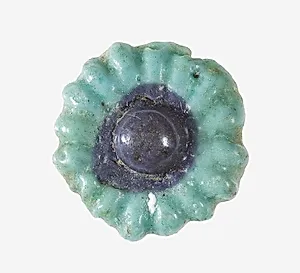
Daisy Pendant
Unknown Artist
ca. 1390–1352 B.C.
Medium
Faience
Dimensions
Diam. 1.5 cm (9/16 in)
Classification
Pendant, daisy
Period
New Kingdom
Department
Egyptian Art
Museum
Metropolitan Museum of Art, New York, NY
Credit
Rogers Fund, 1911
Accession Number
11.215.253
Rights
Public Domain
Tags
Art Historical Context
This delicate **Daisy Pendant**, dating to ca. 1390–1352 B.C. during Egypt's New Kingdom (Dynasty 18), is a petite faience jewel just 1.5 cm in diameter. Crafted by an unknown artist, it captures the era's opulent artistry at a miniature scale, when Egypt was at the peak of its power under pharaohs like Amenhotep III and Akhenaten. Such pendants were likely worn as necklaces or earrings, blending everyday adornment with symbolic meaning. Faience, a molded ceramic glazed with vivid turquoise or blue frit, was a hallmark of New Kingdom craftsmanship. Affordable yet jewel-like, it imitated costly lapis lazuli and turquoise, making beauty accessible beyond royalty. The daisy shape—evoking blooming flowers tied to renewal and the sun god Ra—highlights Egyptians' reverence for nature's cycles, often infusing personal ornaments with protective or life-affirming vibes. Now in the Metropolitan Museum of Art's Egyptian Art collection (Rogers Fund, 1911), this tiny treasure invites us to marvel at ancient ingenuity: how a simple flower form endures as a window into a vibrant world.