
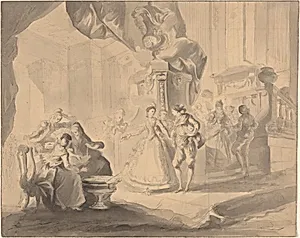
Dance in a Palace
c. 1770/1775
Medium
pen and black ink with gray wash over graphite and squared in graphite on laid paper
Dimensions
overall: 26.5 x 33.1 cm (10 7/16 x 13 1/16 in.)
Classification
Drawing
Department
CG-E
Museum
National Gallery of Art, Washington, D.C.
Credit
Gift of the Christian Humann Foundation
Accession Number
1996.128.31
Rights
Public Domain
Art Historical Context
**Dance in a Palace** by Luis Paret y Alcar, created around 1770–1775, captures the opulent world of Spanish courtly life during the Enlightenment era. Paret, a prominent Spanish artist and court painter to Charles III, was known for his elegant Rococo-influenced scenes blending French decorative flair with Spanish grandeur. This drawing likely depicts a lively ballroom gathering in a lavish palace, evoking the refined social rituals of 18th-century aristocracy amid gilded architecture and swirling dancers—a snapshot of leisure and hierarchy in Bourbon Spain. Executed in pen and black ink with gray wash over graphite on laid paper, the work showcases Paret's masterful preparatory technique. The subtle graphite underdrawing, enhanced by precise ink lines and atmospheric gray washes, builds depth and movement. Notably squared in graphite, it was designed for transfer to a larger canvas, highlighting its role as a studiolo gem rather than a finished piece. At 26.5 x 33.1 cm, its intimate scale invites close inspection of intricate details. Housed in the National Gallery of Art thanks to the Christian Humann Foundation, this drawing exemplifies the transitional Rococo style's charm before Neoclassicism's rise. It offers visitors a window into Paret's virtuosity and the cultural splendor of Spain's royal circles, reminding us how sketches like this fueled grand paintings that defined an age.