
Medium
Hard-paste porcelain
Dimensions
Height: 6 3/4 in. (17.1 cm)
Classification
Ceramics-Porcelain
Culture
German, Fulda
Department
European Sculpture and Decorative Arts
Museum
Metropolitan Museum of Art, New York, NY
Credit
The Lesley and Emma Sheafer Collection, Bequest of Emma A. Sheafer, 1973
Accession Number
1974.356.518
Rights
Public Domain
Tags
Art Historical Context
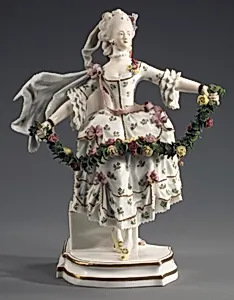
Behold the enchanting *Dancer*, a petite hard-paste porcelain figurine6 3/4 in. high) produced by the Fulda Pottery Porcelain Manufactory Germany around 1785. Crafted during the late Rococo era, this piece depicts a graceful dancer adorned with flowing garlands and flowers,oking the lively spirit of 18th-century European ballet and festive scenes. Modeler Georg Ludwig Bartholoma likely shaped its form, drawing inspiration from the whimsical paintings of French artist Nicolas Lancret, whose celebrated dance and pastoral joy. Fulda, a key German porcelain center from the 1770s onward, rivaled renowned factories like Meissen by mastering hard-paste porcelain—a durable, translucent material fired at high temperatures for fine detail and strength. This technique enabled the manufactory's signature figurative sculptures, blending technical precision with decorative elegance. Such figurines graced aristocratic tables and cabinets, symbolizing refined taste amid Enlightenment-era prosperity. Today, housed in the Metropolitan Museum of Art's European Sculpture and Decorative Arts collection (thanks to the Lesley and Emma Sheafer bequest), *Dancer* offers a glimpse into German ceramic innovation and the cultural fascination with movement and nature. Its delicate poise reminds us how porcelain bridged art and everyday luxury.