
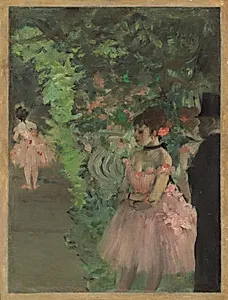
Dancers Backstage
1876/1883
Medium
oil on canvas
Dimensions
overall: 24.2 x 18.8 cm (9 1/2 x 7 3/8 in.) framed: 43.5 × 38.1 × 9.53 cm (17 1/8 × 15 × 3 3/4 in.)
Classification
Painting
Department
CF
Museum
National Gallery of Art, Washington, D.C.
Credit
Ailsa Mellon Bruce Collection
Accession Number
1970.17.25
Rights
Public Domain
Art Historical Context
Step into the enchanting world of Edgar Degas *Dancers Backstage*, captivating oil on canvas painted between 1876 and 1883. Measuring just 24.2 x 18.8 cm, this intimate work belongs to the National Gallery of's Ailsa Mellon Collection. Degas, a master of the Impressionist circle—though he shied from the label—volutionized how we see everyday moments, favoring candid glimpses over grand spectacles. The title hints at Degas' lifelong fascination with the ballet world of 19th-century Paris, particularly the Opéra, where he captured dancers in unguarded backstage repose. Far from the stage's glamour, these scenes reveal the toil and transience of performers adjusting costumes or resting between acts. His oil technique on canvas allowed for rich, layered textures and subtle light play, evoking the dim glow of gaslit dressing rooms. This small-scale gem underscores Degas' innovative approach: asymmetrical compositions and a voyeuristic intimacy that pull viewers into hidden realms. A testament to his enduring legacy, it invites us to ponder the artistry behind the performance.
About the Artist
Edgar Degas · 1834–1917
Edgar Degas (1834-1917) stands as one of the most innovative artists of the nineteenth century, whose distinctive vision transformed how modern life could be depicted on canvas. Born Hilaire-Germain-Edgar De Gas in Paris to a wealthy banking family—his father French, his mother a Louisiana Creole from New Orleans—Degas received a classical education before abandoning law studies in 1855 to pursue ...