
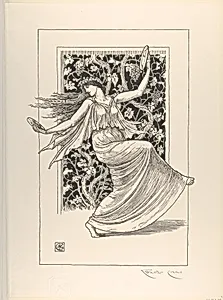
Dancing Nymph (Nymphe Danseuse)
Medium
Lithograph
Dimensions
Image: 17 1/16 × 10 3/4 in. (43.3 × 27.3 cm) Sheet: 23 3/16 × 16 1/4 in. (58.9 × 41.3 cm)
Classification
Prints
Department
Drawings and Prints
Museum
Metropolitan Museum of Art, New York, NY
Credit
Rogers Fund, 1922
Accession Number
22.82.1-85
Rights
Public Domain
Tags
Art Historical Context
Behold the enchanting *Dancing NymphNymphe Danseuse)*, a lithograph created in 1895 by British artist Walter Crane in collaboration with French illustrator André. Measuring 17 1/16 × 10 3/4 inches on a larger sheet, this print the whimsical spirit of late 19-century decorative arts. Crane a key figure in the Arts Crafts movement and an early proponent of Art Nouveau influences, was renowned for his flowing lines and fairy-tale illustrations, while Marty's expertise in lithography brought technical finesse to the medium. Lithography, a planographic printing technique invented in the late 18th century, exploded in popularity by the 1890s for its ability to reproduce intricate details and vibrant colors affordably—perfect for posters, books, and fine art multiples. This work exemplifies that era's fin-de-siècle fascination with classical mythology, where nymphs symbolized ethereal beauty and nature's grace. The dancing figure evokes the Belle Époque's celebration of movement and fantasy, bridging British and French artistic traditions. Acquired through the Rogers Fund in 1922, *Dancing Nymph* resides in the Metropolitan Museum of Art's Drawings and Prints department, highlighting the era's printmaking revolution. Visitors are drawn to its lively tags—dancing and nymphs—that promise a joyful glimpse into a world of mythic reverie.
About the Artist
Walter Crane|André Marty · 1845–1915
British artist, illustrator, and designer.