
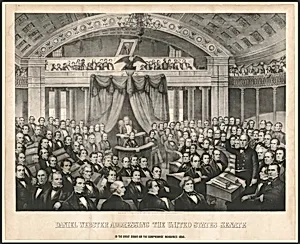
Daniel Webster Addressing the United States Senate
Medium
Classification
Department
Smithsonian Collection
Museum
Smithsonian American Art Museum
Credit
National Portrait Gallery, Smithsonian Institution; gift of Marvin Sadik
Accession Number
NPG.80.226
Rights
Public Domain
Tags
Art Historical Context
In the grand tradition of 19th-century American portraiture, Elipet M. Brown, Jr.'s 1860 print *Daniel Webster Addressing the United States Senate* immortalizes one of the nation's most eloquent statesmen. Created as a detailed reproductive print—likely after an earlier painting—this work depicts Webster at the Senate podium in a neoclassical legislative chamber, gesturing passionately amid quills, books, draped fabrics, and symbolic motifs like an eagle and escutcheon. Eyeglasses perched on his nose and a lawyerly gravitas underscore his role as orator and chancellor, with architectural columns evoking the authority of American democracy. Daniel Webster (1782–1852), senator from Massachusetts and New Hampshire, served as Secretary of State under Presidents William Henry Harrison and Millard Fillmore, whose presence is evoked in the scene. Renowned for his thunderous speeches defending the Union—most famously his 1830 reply to Robert Hayne—this image captures the eve of the Civil War, when Webster's legacy as a nationalist loomed large. Produced in 1860, the print reflects a cultural reverence for his compromise efforts, like the 1850 debates, making it a poignant emblem of pre-war political fervor. Housed in the Smithsonian American Art Museum's collection (gift to the National Portrait Gallery by Marvin Sadik), this piece highlights the era's printmaking techniques, which democratized access to heroic imagery for a broad audience, blending portraiture with patriotic symbolism.