
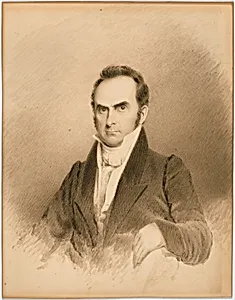
Daniel Webster
Medium
Drawing
Classification
Drawing
Department
Smithsonian Collection
Museum
Smithsonian American Art Museum
Credit
National Portrait Gallery, Smithsonian Institution; given in memory of Gertrude T. Longacre by Mark B. Thompson
Accession Number
NPG.2015.128
Rights
Public Domain
Tags
Art Historical Context
In 1833, engraver and portraitist James Barton Longacre (1794–1869) captured the commanding presence of Daniel Webster in this striking drawing, now housed in the Smithsonian American Art Museum's National Portrait Gallery. Longacre, renowned for his precise likenesses that later graced U.S. coins and banknotes as Chief Engraver of the Mint, employed graphite or ink on paper to convey Webster's intellectual vigor and statesmanlike gravitas. This preparatory-style work exemplifies early 19th-century American portraiture, where drawings served as studies for engravings that disseminated prominent figures' images through print media. Daniel Webster, the legendary orator and lawyer from Massachusetts and New Hampshire, was a towering figure in American politics during the antebellum era. Serving as Secretary of State under Presidents Harrison and Tyler, he championed nationalism and unionism, most famously in his 1830 Senate speech declaring, "Liberty and Union, now and forever, one and inseparable!" Longacre's depiction immortalizes Webster at the height of his influence, embodying the era's ideal of the self-made statesman. This intimate drawing, gifted in memory of Gertrude T. Longacre, highlights the cultural reverence for Webster as a symbol of eloquence and leadership. It invites visitors to reflect on how visual portraits shaped public perceptions of America's founding ideals amid growing sectional tensions.