
Dark Single Hollyhocks
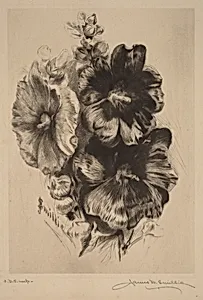
Medium
drypoint in black
Dimensions
plate: 17.1 × 12 cm (6 3/4 × 4 3/4 in.) sheet: 27.1 × 23.2 cm (10 11/16 × 9 1/8 in.)
Classification
Department
CG-W
Museum
National Gallery of Art, Washington, D.C.
Credit
Reba and Dave Williams Collection, Gift of Reba and Dave Williams
Accession Number
2008.115.4473
Rights
Public Domain
Art Historical Context
James David Smillie's *Dark Single Hollyhocks* (1890) captures the elegant drama of these towering flowers in a masterful drypoint print. Smillie, a leading American etcher of the late 19th century, was renowned for his precise yet atmospheric renderings of nature, influenced by the etching revival that emphasized the medium's expressive potential. Created during a period when artists like James McNeill Whistler championed intaglio techniques, this work exemplifies the intimate scale of fine art prints—its plate measures just 17.1 × 12 cm—inviting close contemplation. Drypoint, Smillie's chosen technique, involves scratching directly into a copper plate with a sharp tool, raising a soft burr that holds ink and produces velvety, textured lines. This method lends the hollyhocks a rich, shadowy depth, their "dark" forms emerging with subtle tonal gradations against the sheet's larger format (27.1 × 23.2 cm). Unlike smoother etchings, drypoint's organic richness suited floral subjects, evoking the Aesthetic Movement's reverence for beauty in everyday botany. Housed in the National Gallery of Art as part of the Reba and Dave Williams Collection, this print highlights Smillie's skill in transforming humble hollyhocks into poetic icons, bridging Victorian ornamental traditions with modern printmaking innovation. A quiet gem for visitors seeking the tactile allure of 19th-century American art.