
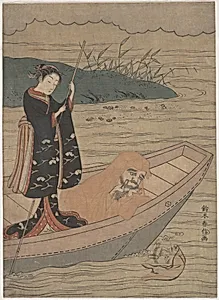
Daruma in a Boat with an Attendant
ca. 1767
Medium
Woodblock print; ink and color on paper
Dimensions
H. 11 1/4 in. (28.6 cm); W. 8 1/8 in. (20.6 cm)
Classification
Prints
Culture & Period
Japan · Edo period (1615–1868)
Department
Asian Art
Museum
Metropolitan Museum of Art, New York, NY
Credit
H. O. Havemeyer Collection, Bequest of Mrs. H. O. Havemeyer, 1929
Accession Number
JP1625
Rights
Public Domain
Tags
Art Historical Context
Suzuki Harunobu's *Daruma in a Boat an Attendant* (ca. 1767) is a delightful woodblock print from Japan's Edo period (16151868), exemplifying the ukiyo-e tradition of "pictures of the floating world." Harunobu a pioneering artist, revolutionized printmaking around 1765 by introducing full-color *nishiki-e* (brocade pictures), layering vibrant inks and colors on paper through intricate woodblock carving. This intimate *ōban* format (11¼ × 8⅛ in.) captures the essence of everyday whimsy blended with cultural icons. The scene humorously reimagines Daruma, the legendary bearded founder of Zen Buddhism, reclining in a boat tended by a graceful attendant—likely a woman, as suggested by the print's tags. Such playful depictions humanized revered figures, reflecting Edo Japan's vibrant urban culture where monks mingled with the masses amid rivers and boats symbolizing life's fleeting journey. Harunobu's delicate lines, subtle gradations (*bokashi*), and vivid hues evoke a serene yet mischievous moment. Housed in the Metropolitan Museum of Art's Asian Art Department from the H.O. Havemeyer Collection, this print highlights ukiyo-e's role in democratizing art for the masses, influencing global aesthetics from Whistler to modern anime. A charming window into 18th-century Japanese life! (198 words)
About the Artist
Suzuki Harunobu · 1725–1770
Suzuki Harunobu (c. 1725-1770) was a Japanese ukiyo-e artist who revolutionized woodblock printing by developing nishiki-e—full-color prints using multiple woodblocks—in 1765. Before Harunobu, Japanese prints were limited to two or three colors; his innovation unleashed the entire artist's palette, transforming ukiyo-e into the vibrant art form that would later captivate Western artists from Manet...