
Das Schloss Prediama in Crein XII Stund: von Triest (Predjama Castle in Carniola, Twelve Hours from Trieste)
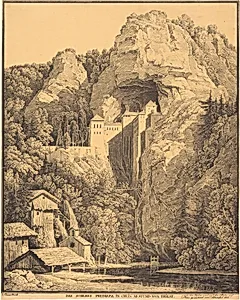
Medium
lithograph on golden paper (on R.A. Winkler's original mat)
Dimensions
sheet: 39.1 x 31.1 cm (15 3/8 x 12 1/4 in.)
Classification
Department
CG-E
Museum
National Gallery of Art, Washington, D.C.
Credit
Pepita Milmore Memorial Fund
Accession Number
1999.52.1
Rights
Public Domain
Art Historical Context
Behold the dramatic lithograph *Das Schloss Prediama in Crein XII Stund: von Triest* (Predjama Castle in Carniola, Twelve Hours from Trieste), created by the renowned Prussian architect and artist Karl Friedrich Schinkel in 1816. This captivating print, measuring 39.1 x 31.1 cm, captures the legendary Predjama Castle—a real fortress dramatically wedged into a cliffside cave in present-day Slovenia. Schinkel, a master of Neoclassicism and Romanticism, sketched such evocative landscapes during his European travels, blending precise architectural detail with the sublime power of nature. Printed on rare golden paper and mounted on R.A. Winkler's original mat, this work exemplifies early lithography, a revolutionary technique invented just two decades earlier. Lithography allowed artists like Schinkel to translate fluid drawings directly onto stone for reproduction, preserving the spontaneity of his on-site observations while evoking the Romantic fascination with remote, picturesque sites. As part of the National Gallery of Art's collection (acquired through the Pepita Milmore Memorial Fund), it offers a window into 19th-century grand tours, when travelers ventured from bustling Trieste into the rugged Adriatic hinterlands. Predjama Castle itself, perched impossibly high, inspired tales of knightly defiance—most famously, the 15th-century rebel Erazem Lüder, who held off armies from its caves. Schinkel's view immortalizes this blend of human ingenuity and untamed geology, inviting us to marvel at a vanished era of exploration.
About the Artist
Karl Friedrich Schinkel · 1781–1841
German architect.