
David and Bathsheba
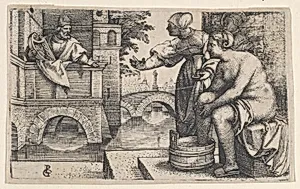
Medium
Engraving; first state of two (Landau)
Dimensions
Sheet: 1 7/8 × 3 1/8 in. (4.8 × 7.9 cm)
Classification
Prints
Department
Drawings and Prints
Museum
Metropolitan Museum of Art, New York, NY
Credit
Rogers Fund, 1922
Accession Number
22.36.20
Rights
Public Domain
Tags
Art Historical Context
Georg Pencz's *David and Bathshe* is a delicate engraving capturing a pivotal biblical moment from Second Book of Samuel. The scene depicts King David gazing upon Bathsheba as she bathes, her nude form gracefully rendered amid architectural elements and attendants. Created in the first state of two—meaning the earliest, unaltered version—this tiny print (just 1 7/8 × 3 1/8 inches) exemplifies the precision of Renaissance printmaking. Pencz, a German from Nuremberg (c. 1500–1550) and one of the "Little Masters," specialized in small-scale engravings that rivaled painting in detail. Working in the Northern Renaissance tradition, he employed fine, intricate lines to convey texture, light, and emotion, making complex narratives accessible. This work reflects the era's fascination with Old Testament stories, blending moral allegory with sensual humanism influenced by Italian art. As a Rogers Fund acquisition at The Metropolitan Museum of Art, this engraving highlights the revolutionary role of prints in 16th-century Europe. Easily reproducible and portable, it allowed biblical imagery to reach collectors and households, sparking reflection on themes of desire, power, and repentance. A gem for any visitor, it invites close inspection to appreciate Pencz's masterful burin work.
About the Artist
Georg Pencz · 1490–1550
Comment on works: Religious; History; Portraits