
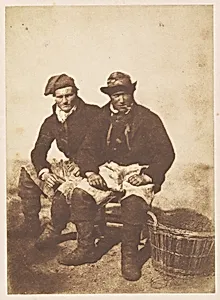
David Young and Unknown Man, Newhaven
Medium
Salted paper print from paper negative
Dimensions
Image: 6 1/8 × 4 7/16 in. (15.6 × 11.3 cm)
Classification
Photographs
Department
Photographs
Museum
Metropolitan Museum of Art, New York, NY
Credit
Bequest of Maurice B. Sendak, 2012
Accession Number
2013.159.23
Rights
Public Domain
Tags
Art Historical Context
In the mid-1840s, photographers David Octavius Hill and Adamson captured the rugged character of everyday Scots in their groundbreaking calotype portraits. *David Young and Unknown Man, Newhaven* (1845) exemplifies their partnership, which produced over 2,500 between 1843 and 1848. Set against the fishing village of Newhaven near Edinburgh, this salted paper print depicts two men—likely local fishermen—standing with quiet dignity, their faces and postures revealing the hardships and resilience of working-class life. The calotype process, using a paper negative to create salted paper prints, was a revolutionary technique that allowed for subtle tonal gradations and artistic manipulation, bridging photography's mechanical precision with Hill's painterly background in Romanticism. Unlike sharper daguerreotypes, these soft-focused images invited interpretive depth, elevating portraiture to fine art. This 6⅛ × 4⅞-inch work highlights early photography's cultural role in documenting vanishing traditions amid Scotland's industrial changes. Bequeathed to the Metropolitan Museum of Art by Maurice B. Sendak in 2012, it remains a testament to Hill and Adamson's brief but luminous collaboration, which helped establish photography as a medium of profound human insight.
About the Artist
Robert Adamson|David Octavius Hill|Hill and Adamson (British, Scottish|British, Scottish|British, Scottish) · 1802 |1821 |1843 –1870 |1848 |1848
British, Perth, Scotland 1802–1870 Edinburgh, Scotland|British, St. Andrews, Scotland 1821–1848 St. Andrews, Scotland|British, active 1843–1848